
Why We See The Worst in Others
Unmasking Projection
I wonder why people project. Projection is central to understanding the human psyche and the interesting ways our minds work. The renowned Swiss psychiatrist Carl Jung shed significant light on this common human experience. He described projection as an unconscious, or unknowing, habit where we take parts of our own personality – often feelings, desires, or traits we haven’t recognised in ourselves – and see them as belonging to other people or even objects. It’s as if our conscious mind, the ego, tries to sidestep looking at these inner parts directly, especially if they might make us uncomfortable or challenge the way we usually see ourselves.
Do people project from a desire to label? Or do they do so from a desire to pawn off their own experience onto another? Sometimes people cannot feel their own sadness, or understand themselves by themselves. They need the canvas of another human being to paint the forms and feelings that swim in their consciousness. But the final part of this equation rarely comes. All the judgements that are imposed onto this person are not taken back as symptoms of the accuser.
These ‘rogue feelings’ are often what Jung termed the Shadow. The Shadow represents the less known side of our personality, containing aspects we might hide or not be aware of, often because society or our own self-image finds them unacceptable. It’s not as simple as calling it ‘evil,’ but rather about all the things within us we haven’t owned or accepted. Because it can be hard to see these traits in ourselves, we unconsciously ‘cast’ this shadow onto others. For example, someone who strongly criticises what they see as arrogance in others might be unknowingly dealing with their own unacknowledged feelings of superiority.
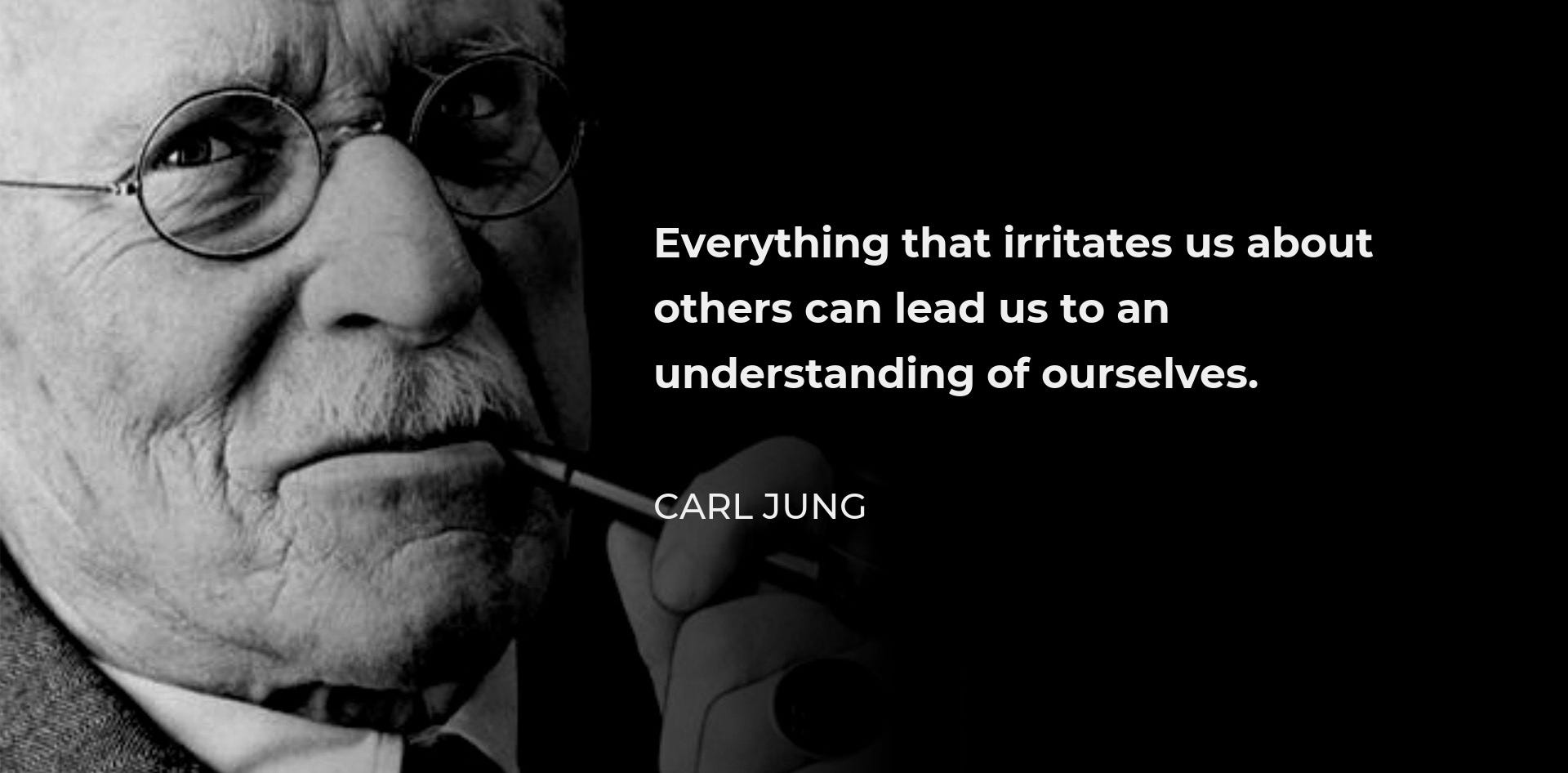
In this way, the world can become a mirror reflecting these disowned parts of who we are. As Jung himself suggested,
Projection, Reflection and Connection
This tendency to project is far more common than perhaps we realise, but it begs the question: how unhealthy is this for a person’s self-awareness? For a person to be aware of their own feelings, often they must not have anyone to project them onto, or perhaps only onto a silly object which seems so irrelevant that the person will eventually take back their feelings into themselves.
The problem here is that projected feelings often are hard to distinguish from genuine empathy. A crucial distinction must be made. Empathy, at its core, is the capacity to understand and share the feelings of another; it is to feel with them. While the Dutch term ‘medelijden’ (often translated as pity or compassion) literally suggests ‘suffering with,’ true empathy, or ‘inlevingsvermogen’ as it’s also termed in Dutch, goes beyond merely feeling sorry for someone. It involves a resonance with the other’s specific emotional state, an attunement to their reality. Thus, empathetic feelings are responsive and adapt to what the other person is genuinely experiencing.
But projected feelings are different. They often don’t vary in flavour. For if the person doing the projecting is trying to unconsciously push their feelings outward and continuously failing to recognise them as their own, these projections will contain a repeated flavour. Imagine a person who simply pities everyone around them, everyone they meet, and their own suffering is eclipsed by this intense pity for anyone below them (economically). Projections do not change based on the state of the person suffering; they remain attuned to what the person doing the projecting is unable to feel.
 Photo by Gabriella Clare Marino on Unsplash
The care someone wants to give the whole world is a simple reminder for this person to give care to themselves, which they often don’t do. The harsh discipline someone levies on all those around him is a reminder for this discipline to be applied to himself too. Someone treats everyone’s feelings as fragile and breakable and that’s because they harbour such fragility in themselves. A person who hates themselves (and hates their parent) ends up finding faults in the whole world, wishing things were a bit more ideal. The saying comes to mind, one which is very apt in these descriptions: ‘if it smells like shit everywhere, check under your nose.’
So you see, the whole game is about self-realisation, but that often doesn’t come because most of us are too busy pointing fingers at someone else. Judging them from our lenses, and in this way, we neither make a connection with this person nor understand the depth of their suffering. Our own pain, our own emotion stays hidden to us as a mask that the other wears, but we regularly fail to realise that we are imagining a mask of our own making. We are telling the person what they should feel, and if we truly notice what that entails, we will realise it is a feeling we deny to ourselves.
Paradoxically, such inaccessible feelings are the easiest to project, for they carry little weight for our conscious minds. Subconsciously we are burdened with these feelings, but to our regular everyday awareness, we might as well feel lucky that we don’t have to bear the pain of such emotion. It is a fascinating thing how we hide things from ourselves, by ourselves.
The Role of the Ego
I wonder if our mind does this purposely to create some kind of protective barrier? Or does this happen as a consequence of something else? Perhaps the latter is more likely. If we combine both of these reasons, we will find that this protective barrier resembles the ego.

Indeed, the ego, as Jung understood it, is the centre of our conscious mind—our sense of ‘I’ that we show to the world and how we see our daily life. However, it’s important to remember that the ego is not the complete picture of who we are—even though it pretends to be ‘the whole’. The whole self, according to Jung, also includes the vast unconscious mind. The ego often acts like a manager, trying to keep our self-concept consistent and comfortable. This ego creates an image for the person which includes permissible feelings and other feelings which are not allowed, which do not fit this persona. So the ‘rogue feelings’ are pushed away into the subconscious where they stay.
The ego is an interface, a way for us to interact with our environment—social, cultural, physical. The feelings it has pushed down must be expressed and will be expressed, for the ego may hide them from us, but it cannot remove them. So they come up as judgements, as ideas, as rapid thoughts preventing us from falling asleep. Since they do not fit in the ‘persona’ they will leak out as deficiencies in someone else, as problems in the world and as inadequacies of one’s experience. So, the feelings will come out, no matter what we do, but they will resist our conscious awareness.
That is one of the main things we can do in identifying these projections. But how do we begin this delicate work of identification? It often starts with cultivating a habit of rigorous self-honesty and asking ourselves incisive questions when we experience strong reactions to others:
-
Is my emotional response – be it anger, irritation, intense admiration, or pity – disproportionate to the actual situation or the person’s actions?
-
Do I find myself consistently attributing the same specific faults, virtues, or motives to different people in my life?
-
Is there a pattern in the advice I give or the ‘help’ I feel compelled to offer, perhaps reflecting an unaddressed need or struggle within myself?
-
Does this person or situation remind me intensely of unresolved issues from my past, or of characteristics I dislike (or secretly desire) in myself?

Jung also spoke of the ‘hook’ in projection. We don’t typically project onto a complete blank slate. Often, the other person possesses a slight trait, a faint reminder or suggestion of the quality that we then unconsciously seize upon and magnify with the full force of our own unacknowledged content. This ‘hook’ makes the projection stick, and makes it more believable to our own ego, because there’s a ‘kernel of truth’ that our unconscious latches onto.
In the end, we are human beings delicately woven into a world that wishes to be understood through us. We are part of the world and intimately connected to each other through the human organism. No matter how much the lies of individualism may push us away from each other, our subconscious will always find a way to remind us of these facts.
So, all we need to do is to pay attention to our projections, to pay heed to the way we see the world. To try and decipher what colour we are painting the world and then ask ourselves why. Our unique flavour of viewing the world is a key and an important part of understanding ourselves.
This journey of getting honest with ourselves, of withdrawing our projections and integrating these disowned parts, is at the heart of what Jung called individuation. Individuation is the lifelong process of becoming the unique, whole, and authentic individual one is meant to be. It involves differentiating oneself from the collective while also embracing the fullness of one’s own being – including the shadow. By paying attention to what we cast out onto the world, we gather the lost pieces of ourselves, moving towards a more complete and conscious existence.
The more we can get closer to ourselves and honest with ourselves, the more we engender the same kind of change in the world. What if it’s worth it?