

We Dont Know How To Spend Our Time
Two people walk the street. One admires the beauty of spring, the orange flowers and the purple ones near their feet. Red flowers adorn a barren tree as it tries to find its leaves. The birds sing as many have returned from their journeys south to feast on the spring delights. The air feels cool on the face, yet not the piercing cold of winter.
The other person, just looks at their phone. They walk expressionless as their thumb scrolls on one of the five major apps—only looking up to check where they’ve reached.
A small example of two wildly different experiences in the same reality. This is what it has come to. I read a recent report of a man who was convicted 30 years ago and was just released from prison earlier this year. He got out and his first comment was “Everyone is hunched over their phones.”
Photo by Mark Olsen on Unsplash
The War for Attention
It is a sad truth that many see but no one can do anything about. The real world, outside our phones, does not have the allure, the charm or the quick cuts, dance steps and attractive people we see on our digital devices. There is a war for your attention and currently, screens are winning.
But how does this affect how we spend our time? Well energy goes where attention flows. So, today we are a society plagued with two ills: Efficiency and utility. We have been indoctrinated into a world where these qualities are important and while there may be far reaching effects to this ‘way of life’, what we have lost is also our ability to spend our time in the way we used to.
I have talked previously that leisure is the ability to do what one wants with one’s time. Most of us have become accustomed to see leisure in our phones. A little mindless scroll here and there keeps our anxieties at bay. But what if these precise activities are the source of our existential anxiety in the first place?
It is a grand task to say what the purpose of human beings on this planet is, so I won’t do that. I will point to the fact that our bodies, minds, souls, spirits—essentially our entire beings—are much more intelligent and aware than we give them credit for.
The industrial era ethos of conquering nature, having direct control over all that moves and making it work efficiently according to our desires is still somewhat present today. We are flooded with influencer videos pushing “facts” on us, on how to hack your body, how to streamline our digestive system and so on. When the simple problem may be: we don’t move enough.

Our lives are far more sedentary than our ancestors who lived off the land. Our lives are far more isolated than our ancestors who lived in community and in joint families. Our lives are pacified by digital screens that offer us content to amuse, sedate and astonish.
These pacifiers with batteries keep us living in ruts and ways we do not even think to be unhealthy. So, to understand this, we must explore the simple idea of ‘Brain Rot’. What happens to our brains when we are given content that switches images very quickly? When we are given content that is taken out of context only to give us the funny bit?
Recent research from neuroscientists at Oxford University suggests that our neural pathways are literally reshaped by digital engagement patterns. The brain adapts to the rapid switching between stimuli by building stronger connections for novelty-seeking and weaker ones for sustained attention—a physical manifestation of what is aptly described as “Brain Rot.”
What happens is we lose the ability to focus. This constant flood of amusement also undermines the cognitive abilities we need for purposeful and meaningful activity. Just like we apply our minds to work we need to apply them for our leisure. We need the capacity to focus to engage deeply with ideas and to find meaning beyond entertainment. Remember, our brain is plastic and Brain Rot is precisely how our consumption of media shapes our cognitive abilities. It also shapes our expectations of reality and we end up losing the complex thinking needed for meaningful activities.
Amusing ourselves to death: A Historical Perspective
Neil Postman’s book ‘Amusing Ourselves to Death’ says that media doesn’t just shape what we think about, but how we think. He compares Orwell’s ‘1984’ and Aldous Huxley’s ‘A Brave New World’ and believes Huxley’s prediction is more accurate: we have become a culture seeking constant amusement, willingly surrendering our capacity for serious thought.
The book takes a journey into how media developed. Many societies were oral cultures for the most part until the printing press brought the written letter, or typography, to many people. The telegraph and photography changed this as people were then exposed to ‘snapshots of information’ which was usually decontextualised.
The slow preference of images over words was accelerated by television where all public discourse took on the form of entertainment. Television’s emphasis on visual appeal and entertainment value started to change politics, religion and education. Political discourse started to become a personality contest. One of the first, and major, examples of this was the election of Ronald Reagan, who used to be an actor. Before this, people who listened to the Kennedy-Nixon debate on the radio favoured Nixon, but people who watched it on TV favoured Kennedy.
Postman even criticised Sesame Street with a valid point. He says the show, while well-intentioned, taught children that learning should be entertaining which fundamentally altered expectations about knowledge acquisition. The truth of the learning process is that it is gruelling and it gets much worse before it gets better. Knowing something is superficial endeavour, understanding something is a struggle (but worth it).
He was particularly concerned about the “information-action ratio”. How much of the information you read can you take action on? We receive vast amounts of information we can do something about and this creates a kind of paralysis that is masked as ‘being informed’. Television privileges immediate, visual truth over complex understanding, distributing decontextualized facts that leave viewers simultaneously knowing more and understanding less.
Media affects our cognitive abilities. The constant stimulation of entertainment slowly wears away our capacity for sustained attention, logical thought and deep reading. Over-reliance on media makes us accustomed to receiving information in brief, entertaining segments which makes us incapable of engaging with complex ideas requiring sustained focus.
This is not a call to reject media, Postman says, it is a call to develop “media consciousness” to understand how different forms of media shape our thinking and then choosing how to use media consciously. He argues that keeping space for the written word is absolutely crucial to maintain our capacity for logical, sequential thinking. In this way we avoid becoming what Huxley warned of: People who “love their oppression” and “adore the technologies that undo their capacities to think.”
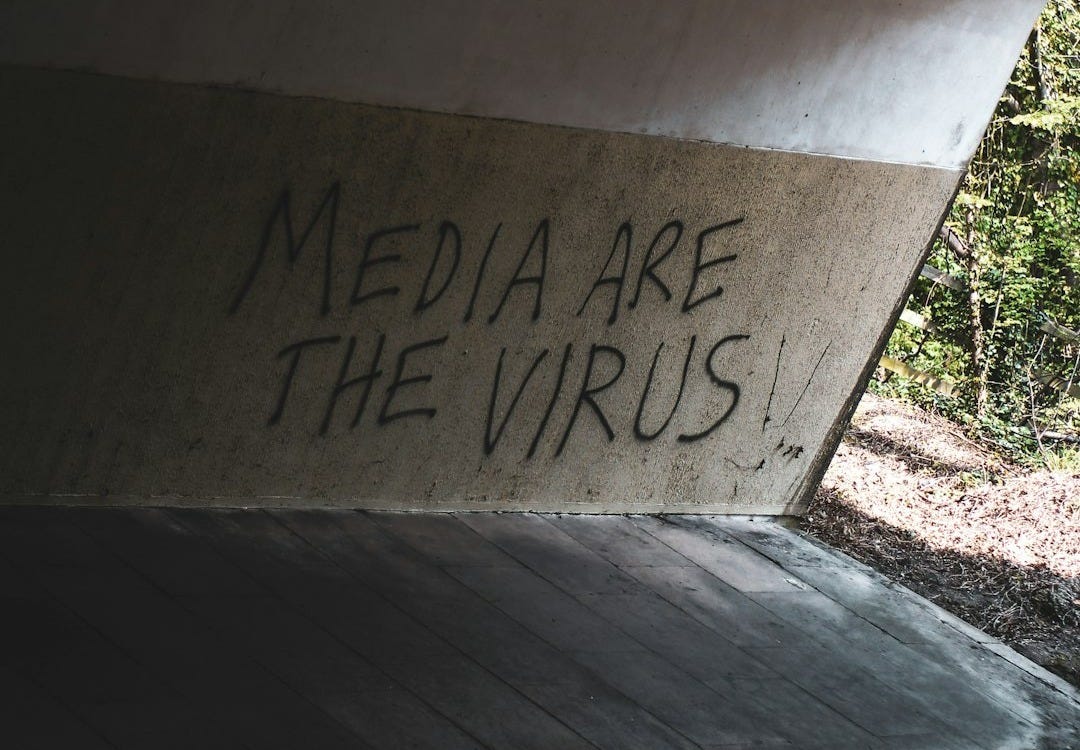 Photo by fabian jones on Unsplash
Postman’s insights on television now seem almost cute in the age of social media. What he diagnosed as a troubling shift—from typographic culture to television—has accelerated exponentially with platforms like TikTok, Instagram, and Twitter. Where television offered decontextualized snippets in 30-minute segments, social media delivers them in 30-second bursts, further fracturing our attention spans. The algorithms that drive these platforms amplify and reshape our preference for entertainment, creating feedback loops that privilege emotional reaction over reasoned response. Today, we swim in oceans of information while our capacity for meaningful action drowns.
Reclaiming Our Time: Making Reality Primary
Philosophers from Husserl to Merleau-Ponty have explored what they call phenomenological presence the quality of being fully immersed in one’s immediate lived experience. This state of attentive engagement with reality is an active, intentional way of perceiving that allows the world to reveal itself to us in its rich complexity. When we achieve this quality of presence, the ordinary becomes extraordinary—the veins of a leaf, the texture of wood grain, the subtle emotions crossing a loved one’s face all reveal themselves with surreal clarity. This is a fundamental human capacity that we’ve allowed to waste away in our rush toward constant digital stimulation. Reclaiming this capacity begins with recognizing what we’ve lost—a way of being in the world that makes life meaningful.
So many of us feel we should be doing something valuable with our time. So many of us feel we want to start a new project, something fulfilling and meaningful. So many of us would like to paint, write, sing—or learn these things—but we somehow never get around to it. So many of us can’t really remember how a day passes, just that it does. What did we do? Some work and the rest of the gaps were filled in by screens.
Making reality primary means reconnecting with the physical world around us. The Japanese practice of “shinrin-yoku” or forest bathing offers a powerful counterpoint to digital immersion. Studies show that simply being present in natural settings for as little as 20 minutes significantly reduces cortisol levels and increases activity in the prefrontal cortex—the very region that digital overwhelm tends to diminish.
I really do wonder if people think constantly living digital realities is okay. Or have people also lost the ability to self-reflect on their actions? While I don’t think screens are inherently bad but like any tool, it depends on how one uses it. Currently, it seems we are using screens to distract and numb ourselves.
The worst part is the vicious cycle it promotes. When we use screens too much, our beings revolt. They ask us to engage with reality instead of the virtual world. This causes us discomfort and anxiety—especially for those who cannot tune into the message of their feelings or intuition. The anxiety we feel is not manageable since now we are isolated individuals, we have work pressure and little help. Earlier, communities would help each other in such matters. So, those of us that don’t turn to drugs to solve this anxiety, turn to screens.
And we get hooked onto screens. Most times, I observe people aren’t really watching anything but constantly scrolling, as if enjoying the movement. My own experience of slavery to my screen has taught me that we primarily use this entertainment and distraction as an escape.
One must concede that screens are a new phenomenon for the human consciousness, only with us for the last 20-30 years. Still, we are running out of excuses now. We are either binging screens or trying to take a social media detox. Any limits we set for our screen time use is easily bypassed because our minds are addicted—and an addict knows no limits.
So I felt such a practical essay should end on a practical note. My advice is simple: Make reality primary and make virtual reality secondary. Now most of you will think, “Oh yeah, I already do that.” And I will ask, “Do you, really?” Everything to do with a screen is virtual reality and to take it from a primary experience for our minds to a secondary experience takes effort.
If we are awake for 16 hours a day, can we really use screens for only 2 hours? This includes laptops, TV’s, phone and any tablets. It is not practically possible for many people who need to work on screens but again, it is not the screen but what it is used for. Our work usually requires us to focus, and living a purposeful life also requires us to focus. The challenge we have is to find balance.
Now for those who have more free time, such as artist or people who are retired, they have more of a responsibility to use it wisely. We must actively work to build in meaningful activities in our day. This can be anything, gardening, cooking, sewing, staring at a wall, going for a walk. But we must try and engage with reality, rather than escape it through mindless indulgence in digital media.
There are positive ways to use it too. Learning the names of birds, of flowers and plants on the internet enriches my engagement with the world. Learning how to play music online enriches my experience at home. This essay required sustained focus and I hope it will enrich your future experience.
Again, screens are not bad; we must be careful of letting ourselves fall into bad habits. We must recognize what we are losing in our impulse for mindless distraction. Take your time into your own hands and not your phone. And lastly, don’t let your mind fool you into believing screen use is ‘okay’ when it is not.
I will leave you with this relevant, timely and beautiful poem about being present in a forest.