
Nature And Our Connection To All Of Life
Somehow our connection to nature and our continual search for meaning are tied together at the root.
The other day, I saw my grandmother raise her hands at the sun. The morning light bathing her small body in a golden orange hue as she closed her eyes facing the sun just risen behind the mountain. She then proceeded to offer water from a glass in its general direction.
Watching this beyond a window, conflicting thoughts entered my head. If we just think of the sun as a passive star, a glowing hot ball of radiation, then we’d find this act silly. But in my mind, I saw her alternative as well: the sun was a God that gave unconditionally. She told me later, “It gives us light and its rays do everything for us. I can do nothing for it, except give it water.”
This act seemed to me a more wholesome way of looking at everything. Knowledge and science have made us knowledgeable but not necessarily kinder or more reverent. If science replaced religion, it did not have the effect religion once had. Quite the opposite—it freed us from dogma but also from any kind of mystery and wonder about the universe and life. Despite the fact that science provided us much more enriching and nuanced ways of looking at the world than religion did.
This, I believe science did not intend. If we look at science done with wonder in mind, we see discoveries that can enrich our understanding of the world. Wonder is neither a function of science nor religion, nor any discipline or field of study—it is a function of a mind and heart that are open to experience and to curiosity.
In these simple acts of reverence, we find echoes of an older wisdom—one that saw the sacred in the scientific, the miraculous in the mundane. In his book “The Spell of the Sensuous,” Abram writes, “Our most immediate experience of the world around us is necessarily an experience of its aliveness…. We directly experience things—stones, plants, clouds, as living beings only when we experience ourselves as a part of them, or when we feel ourselves as implicated in their experience.” Abram’s work suggests that a re-enchantment of the world is possible through a embodied and sensorial engagement with nature.
Rachel Carson understood this marriage of wonder and knowledge when she wrote about basic processes in nature that may evoke wonder in us if we looked at them carefully. I will share most of the following as direct quotations as her writing is far too beautiful to need any rephrasing:
The Liver (Quote from “Silent Spring”):
“Of all organs in the body the liver is most extraordinary. In its versatility and in the indispensable nature of its functions, it has no equal. It presides over so many vital activities that even the slightest
damage to it is fraught with serious consequences.”
The liver performs a multitude of functions essential to life. It
processes nutrients absorbed from the small intestine, produces bile to
aid in digestion, and plays a crucial role in metabolism,
detoxification, and immune response. The liver’s ability to regenerate
itself is one of the most remarkable examples of regeneration in the
animal kingdom. This organ, so vital to our survival, is a testament to
the intricate and awe-inspiring design of nature.
Photosynthesis (from “The Sea Around Us”):
“The process of photosynthesis is one of the true miracles of life on earth. It is the means by which green plants utilize the energy of sunlight to build up carbohydrates from the simple raw materials of carbon dioxide and water. In this way, the energy of the sun is captured and stored in a form that can be used by living organisms. The chlorophyll-bearing plants are the primary producers of the organic world, and from them have come, directly or indirectly, the substances that feed all animals. The process of photosynthesis is the basic source of life; without it, the world as we know it could not exist.”
The Water Cycle (from “The Sea Around Us”):
“The water cycle is a vast and never-ending circulation that involves the whole earth and its atmosphere. Water evaporates from the ocean, forms clouds, and returns to the earth as rain or snow. It flows in rivers, gathers in lakes, seeps into the ground, and eventually finds its way back to the sea. This cycle is essential to all life, for water is the universal solvent, the medium in which all the complex chemical reactions of life take place. The hydrologic cycle is a unifying force, linking the sea with the land and the air, and maintaining the delicate balance of life on our planet.”
If we truly look at all this, we may be humbled and find that nature’s intricate design is not too far from magic itself. How all these things happen and continue to happen and sustain themselves is beyond the scope of any discussion or explanation. We may understand parts of it but the whole will be a mystery and I believe it is good that way—it offer us something to imagine, something to wonder about.
These intricate dances of life—from the liver’s quiet wisdom to water’s eternal cycle—pulse with the very heartbeat of our planet itself. The Schumann resonance of 7.83 Hz is also called the Earth’s heartbeat. It is a low-frequency electromagnetic wave that circles the planet, created by lightning and thunderstorms. The Gaia hypothesis, proposed by James Lovelock, suggests that Earth’s biological systems and the planet itself work together as a single entity, with negative feedback loops that keep conditions favourable for life.

As Ralph Waldo Emerson once said, “Nature always wears the colours of the spirit.” This spiritual colouring of nature reflects back to us a deeper truth about our own essence. We look at ourselves as bodies that just revolve around work and are made up of skin, bones, fluids, and gas. Where has the mystical element of life gone? In our pursuit of knowing everything, we’ve discarded the mystery of life that once enriched us with mysticism and magic.
In ancient days, people determined which stars were stars and which were planets merely by looking at the night sky. They used their eyes to see into the darkness beyond the limits of our natural world and gazed into the supernatural. We don’t use our eyes to see anything other than our screens anymore. Life slowly seems to escape us, and we pretend not to notice. This disconnection from wonder stems not from a failure of knowledge, but from a fracture between our thinking and feeling selves.
Our minds seem to turn away from information, ideas, or perspectives that contradict our sense of identity. Most of us don’t look where we’re told not to look. If you call something ‘new-age spirituality,’ then most people who don’t identify themselves with this idea will refuse to even examine the contents of its message. It’s just easily regarded as pseudo-bullshit. Similarly, there are many reasons why ecology is deteriorating and climate change is getting worse—and one of them is because we’re collectively refusing to look.
Just as the water cycle knows no true boundaries, our essence flows beyond the artificial borders of skin and self. Our identity isn’t simply our body, ideas, and ego, but there’s more to us than that. We have a soul, and we can pretend to not know it, but deep down, I think we do. Let’s also not give our soul a characteristic of individualism—our bodies are in ‘the soul.’ We’re all swimming in its vastness, and it’s part of the reason we’re all connected. Our identity is far greater than we think.
But we think and this act of thinking often seems to be a merely superficial one. Overthinking is almost always thinking disconnected from feeling. If thinking is limited to the horizontal, the flat, the wide then feeling is the vertical dimension of the same thing, the height, the depth. To go higher or deeper in our understanding, we must understand what we’re feeling. And we’re not sure what we’re feeling; we’re too busy, we’re too afraid, we’re too pre-occupied with bullshit peddled to us by media sources to even think beyond fear, anger, entertainment and confusion.
The world is not going in a nice direction. It isn’t some pseudoscience of future prediction; we need only look at the present and realize: if things keep going this way, it’s not going to end well. Is there going to be some magic pill that will solve everything? Is some saviour going to emerge from an unknown village and be the cure to all the ills? I’m afraid, if we believe that, we’re putting our eggs in the wrong basket. There is a saviour in all of us. We are all that magic pill. And so, it is our task to find what our soul is trying to tell us and heal the world in the small, unnoticeable ways we can.
In this cacophony of crisis, perhaps what we need most is silence—a space to reconnect with that which we’ve forgotten. As Pablo Neruda wrote in his poem “Keeping Quiet”:

This stillness might reveal what our constant motion conceals—that our economic systems mirror our inner fragmentation. Who cares about the world or the soul, right? We should just be busy making our money, looking at our screens, maintaining our status and power, keeping ourselves busy, and the problem will solve itself. As George Monbiot wrote in The Guardian, “Our economic model is incompatible with the survival of life on Earth.” This sentiment echoes the urgency of our situation and the need for a shift in our priorities.
From “PMC”:
“Even if capitalism, as the dominant economic model, incorporates natural capital into its cost–benefit analysis, nature still loses out; unlimited human growth—the central tenet of capitalism—and sustainable development are incompatible. The scientific community has been highly sensitive to this alarming development and increased the number of baseline and ecological studies on the impact of humans on the biosphere and proposed various strategies to alleviate the environmental and biotic crisis.”
From “Monthly Review”:
“The social relation of capital, as we all know, is a contradictory one. These contradictions, though stemming from capitalism’s internal laws of motion, extend out to phenomena that are usually considered external to the economy. Marx’s analysis of primitive accumulation pointed to the separation of workers from the land as the formative contradiction of capitalism. His critique of political economy highlighted the commodification of all of life and the dominant role played by accumulation without end, rooted in exchange value as opposed to use value. One of the key elements in Marx’s ecological analysis is his theory of metabolic rift. Marx employed the concept of a rift in the metabolic relation between human beings and the earth to capture the material estrangement of human beings within capitalist society from the natural conditions that formed the basis for their existence.”
From “illuminem”:
“The ecological principle ‘nature knows best’ does not work, but rather the anti-ecological principle ‘self-regulating market knows best’ increasingly controls all life under capitalism. For example, food is no longer perceived primarily as a source of nutrition, but as a means of making a profit, so the nutritional value of products is sacrificed in volume. This tendency of ‘commercial capitalism’ to simplify, as the Indian physicist and environmentalist Vandana Shiva notes, ‘is based on the specialized production of goods. The typicality of production requires the one-sided use of natural resources.’”
These systemic failures ripple through both human society and natural systems, creating a web of interconnected crises. Not to mention that natural disasters often set the stage for sociopolitical problems. For example, the driest periods have coincided with periods of political unrest in China, according to a recent study spanning thousands of years of precipitation data, establishing a historical link between climatic stress and social chaos. Given the growing global concerns about climate change, it is crucial to understand historical and current changes in drought and water cycles.
Last year’s record-breaking temperatures could be a sign that the world is entering a new era above 1.5C of global warming, scientists say, one never before faced by modern humans. The Paris Agreement threshold of 1.5 degrees Celsius above pre-industrial levels is a small-sounding number with big implications for people and nature.
With all these changes going on, it is not a surprise that the movement to correct the ill-effects of climate change is popular among the youth. The people who will depart this planet within the next 50 years don’t seem to care all that much. And I get that, but does that really help anyone?
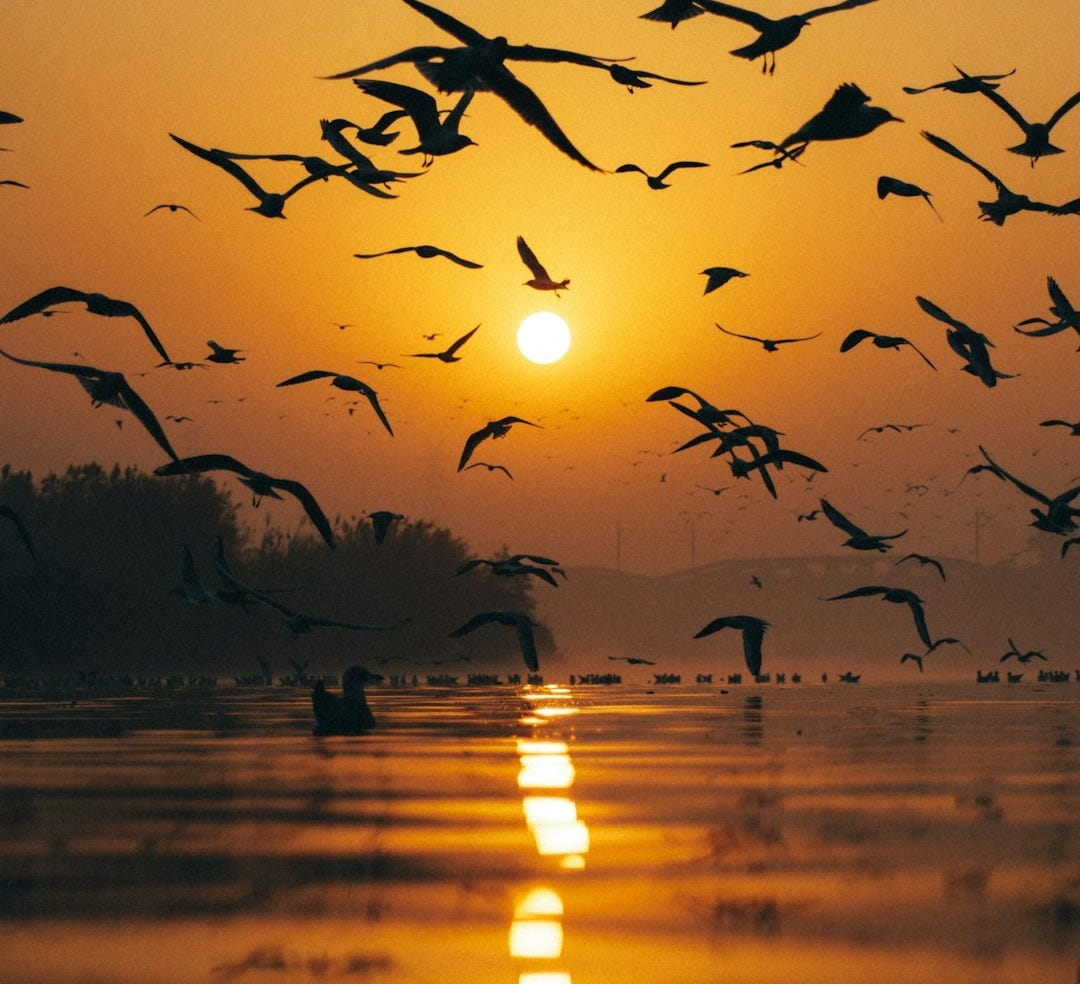 Photo by Anuj Yadav on Unsplash
We may want to reawaken that reverence that once existed in all our cultures. We may want to start seeing the sun as a light-giving entity, imbued with a pure soul that keeps giving—maybe we want to give it some water in the morning to quench its thirst? The question is not whether to pursue these acts; it is to revive what they represented: our participation in a world that’s alive. Our actions then say to the world, “Yes, I want to keep you alive as well.” Right now, it’s not too much of a stretch to say we’re killing the world and with it our collective selves.
Even death as the necessary promoter of life is a wonder in itself. And as we know, but don’t often admit, all life ends in death. The pessimist in me says: ‘Maybe this was the way we were supposed to go.’ But the realist in me chooses to believe there is a greater understanding that guides us and life on this planet. If this is the way it is meant to go, then so be it. Folly might be the scripture mankind has yet to read and understand. Maybe this is the process towards something good. Like the storms, we see as the wrath of the Gods, this too may be a storm passing through our souls. Like all storms, it won’t last forever—and neither will we.
Let’s reawaken our reverence for nature and our connection to all life. Let’s start seeing the world as alive and participate in its aliveness. To conclude I will leave you with one of my favorite poems “Wild Geese” by Mary Oliver:
You do not have to be good.
You do not have to walk on your knees
for a hundred miles through the desert repenting.
You only have to let the soft animal of your body
love what it loves.
Tell me about despair, yours, and I will tell you mine.
Meanwhile the world goes on.
Meanwhile the sun and the clear pebbles of the rain
are moving across the landscapes,
over the prairies and the deep trees,
the mountains and the rivers.
Meanwhile the wild geese, high in the clean blue air,
are heading home again.
Whoever you are, no matter how lonely,
the world offers itself to your imagination,
calls to you like the wild geese, harsh and exciting
over and over announcing your place
in the family of things.
— Mary Oliver, “Wild Geese”