

Money Greed And The Human Pursuit Of Survival
The Primal Drive: From Survival to Status
I wonder why people run after money so much. The kind of desperation and envy they show towards this abstract concept of wealth really has me baffled. Having money or not having money did not affect my sensual experience of the world. Not having money at all did affect it because of hunger, malnutrition etc.
In today’s world, it is such that the basic things of the world have been designed to cost something. But in the economy, the basics are supposed to be the cheapest. One can’t have electronics be cheaper than food. So this makes money important in order to survive—but modern humans are unable to calculate how much.
The instinct to hoard is very present in the modern day in the form of digital currency. This instinct isn’t new but rather a common theme across generations and millennia of humans. The desire for people back in the day to hoard seashells, fine fabric, inert useless metals such as gold and silver, has always come from a survival stand point—but morphed into greed for resources.
It makes sense, humans fear dying and naturally want to survive and this makes them chase whatever avenue there is to increase their chances of survival. But most humans are bad at math. How many seashells do you need to ensure your survival? How many days will you live? What will the weather be on most days? What about the storms, the floods, the wars? What if I need to bribe an invading army? It is in such cases where fear for one’s life comes in that a human being starts hoarding, preparing for a catastrophic eventuality that only exists in their mind.
Erich Fromm, in his book “Escape from Freedom,” argues that greed is often a response to existential anxiety and the fear of insignificance. Fromm suggests that individuals may accumulate wealth as a way to assert their existence and gain a sense of security and control. However, this perspective can be countered by this question: Can greed exist without fear?
Initially, I said no it cannot but then another scenario emerged. Greed can exist with ambition. A desire for power or status can be used to fuel actions that end up in greed—for these things do not have an end. Greed driven by the desire for achievement is clearly showcased in many of today’s entrepreneurial narratives. There isn’t really an end-state of enough achievement, enough power or enough status. One always wants more. And then the trap is set for greed, covetousness, manipulation and other underhanded techniques to get that power or status.
The modern day situation hasn’t changed much but money has become both a symbol of power and an indicator of status. The two things most people want in the world now converge into one thing, almost endowing it with a godlike quality of omnipotence. With money one can do anything! Achieve anything, buy anything, be anyone. Oh, the average mind just drools with possibilities.
The Power Paradox: Wealth and its Anxieties
The desire for money has evolved from a survival need to a symbol of power and status. If we view this evolution through the lens of psychological and sociological theories then Thorstein Veblen’s work comes up. In “The Theory of the Leisure Class” he discusses the concept of conspicuous consumption, where individuals display their wealth as a means of demonstrating their social status. Veblen argues that this behaviour is driven by a desire to gain respect and envy from others.
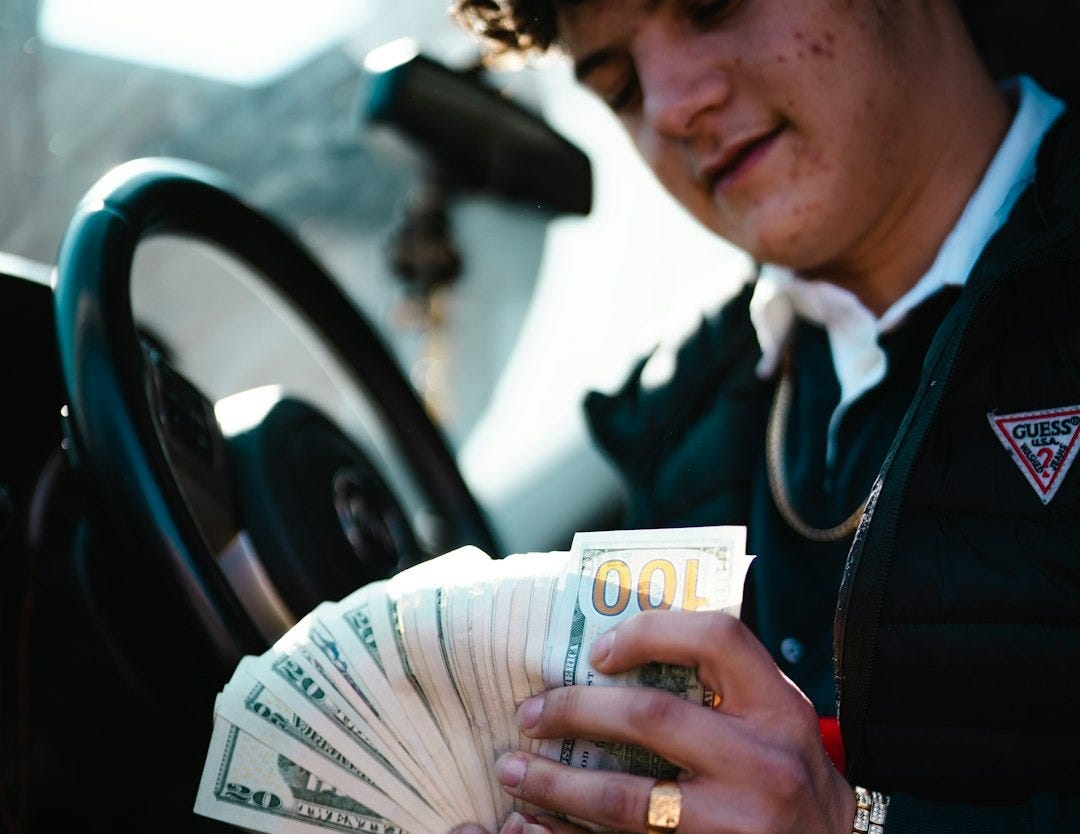 Photo by Brock Wegner on Unsplash
Veblen’s insight is incisive in how he connects economic behaviour to primal social and psychological drives. The leisure class, as he calls the rich, doesn’t simply spend to fulfil material needs—they engage in elaborate displays of “wasteful” consumption precisely because it signals their ability to engage in non-productive activities. The more removed an item or activity is from practical necessity, the more effectively it serves as a status marker.
This creates a peculiar dynamic where objects gain value not through their utility, but through their very impracticality. Think of elaborate formal dining customs, or fashion items that prioritize form over function. The leisure class cultivates tastes and habits that are deliberately inefficient because efficiency would suggest the constraints of productive work.
If we were able to look into the lives of ultra-rich people who have far too much money that they cannot spend it in one lifetime, we would see a deep-seated anxiety. The more one has, the more they are afraid to lose it. The paranoia that accompanies this amount of wealth spreads to all aspects of one’s life.
Such a person cannot always trust members of their own family for they may be covetously eyeing some portion of their wealth. Friendships always come with a hint of favours and this person never knows who’s genuine and who is using them for their wealth. Love, similarly, is fraught with questions such as “Do they love me or my money?” Historically people in power, such as aristocrats, nobles, relations of royalty always had this “problem”. Far from being an issue it has become a question of assessing and analysis.
Max Weber, In “The Protestant Ethic and the Spirit of Capitalism,” argues that the pursuit of wealth can also be seen as a moral obligation, a duty to increase one’s wealth as a sign of virtue and divine blessing. This perspective adds a diverse dimension to our notion that the desire for money is solely rooted in negative emotions like fear or greed. Weber observed that Protestant denominations, particularly Calvinists, viewed worldly success as a sign of God’s favour and predestination, transforming the accumulation of wealth from a potential sin into a religious duty. This theological justification for wealth accumulation helped shape modern capitalism’s ethical framework.
The envy that people feel towards others who have money is often misplaced. Why is there any reason to be jealous of someone who has more resources than you? Maybe because one assumes their life is better—as seen from the outside. Maybe the power they exert on you is wearing you down and you want to exert it on them too. Eventually it comes down to this desire for omnipotence. One wants to be free, to have pleasure, to have leisure and we all mistakenly think money can offer us this.
In the modern day, business rules the time of most humans—no matter how wealthy or poor. The rule of business is one has to keep at it. People who have made their wealth from business activities are afraid to lose it and so must keep the business going. They have people to manage, funds to secure, meetings to attend to and countries to visit—albeit in business or first class. A person, no matter how wealthy, who must serve the demands of a system continually is trapped in the system. It is like a lion that eats all their time. The need to engage in such activities comes from a self-preserving instinct and in this case they must preserve their wealth.
What has been true for centuries still holds true now. Money cannot buy happiness, even if it can rid us of some forms of unhappiness (studies show money does increase happiness but with diminishing returns after basic needs are met). Money cannot buy love but it can buy moments where people might fake love with you. Money cannot buy health but it can offer more opportunities to heal and manage ill-health. And lastly, but most importantly, no amount of money bought a second of time.
The Inequality Machine: System and Society

On the question of leisure, yes a wealthy person might have more time than a labourer who toils for most of their day but are they really? In “The Wealth of Nations,” Adam Smith discusses the division of labour and the economic systems that govern society. Smith argues that while wealth can provide certain freedoms, it also comes with responsibilities and obligations and doesn’t necessarily lead to greater leisure or freedom.
But there are vast disparities in leisure time and work conditions between different socioeconomic classes. This inequality shows up in how people in lower strata must fight for basic things like housing, clean food and water which the upper strata can easily take for granted. Here again the question of ease of survival comes up again and the ambitions of people to move up the social ladder are completely justified.
We must address the growing wealth gap that has become a pressing issue in contemporary society. According to a recent report by Oxfam, while nearly 5 billion people have grown poorer since 2020, the five richest men in the world have doubled their fortunes to $869 billion—that’s a staggering rate of $14 million per hour. Billionaire wealth surged in 2024, with the combined wealth of the world’s richest increasing from $13 trillion to $15 trillion in just 12 months. This marks the second-largest annual increase in billionaire wealth since Oxfam began keeping records. The report also notes that the number of people living in poverty has barely changed since 1990
This stark inequality highlights the systemic issues that perpetuate the desire for money and the illusion of omnipotence it offers. The concentration of wealth in the hands of a few not only exacerbates social and economic disparities but also fuels the misplaced envy and desperation that many feel towards the ultra-rich.
Economist Thomas Piketty, in his seminal work “Capital in the Twenty-First Century,” argues that the trend of increasing wealth inequality is not a accident but a feature of capitalism itself. Piketty’s research shows that the return on capital tends to be higher than the rate of economic growth, leading to a concentration of wealth over time. This perspective challenges the notion that wealth trickles down to benefit all layers of society and instead suggests that the system is rigged in favour of those who already have capital.
The social implications of wealth inequality are profound. Studies have shown that countries with higher levels of income inequality tend to have lower levels of social mobility, poorer health outcomes, and higher rates of crime. These issues are not just economic but also moral and political, raising questions about fairness, opportunity, and the role of government in redistributing wealth. The desire for money, in this context, is not just about individual ambition but also about systemic forces that perpetuate inequality.
Being Versus Having: Rediscovering What Matters
As we draw towards a conclusion we must think of the freedom and leisure we think money can provide.

Is not leisure the ability to decide what to do with one’s time? This ability to decide what to do with one’s time relates to Aristotle’s concept of eudaimonia, or human flourishing. In his “Nicomachean Ethics,” Aristotle argues that true happiness comes from living a life of virtue and excellence, not from the pursuit of wealth or pleasure. This perspective suggests that true leisure is not merely the absence of work but the freedom to engage in activities that are meaningful and fulfilling.
Money is something we get after we do something of value to the economy. But why do we do anything? Getting money or gaining wealth are not meaningful activities in and of themselves—at least, that’s what I believe. There needs to be a deeper intention, like that of the protestant ethic we mentioned earlier. Duty, providing for a family, earning to fund our hobbies are some examples of why people engage in earning money. These intentions, that form the basis for our actions, are usually engaged with the process of living.
To engage in earning money just to earn money is an empty shell and even though this shell may be golden, it is devoid of a life-affirming intention. Meaning and fulfilment come from engaging in these intentions over a long period of time and while money can facilitate this process—a means to an end—it should never become the end.
Immanuel Kant, in his “Groundwork of the Metaphysics of Morals,” discusses the concept of moral worth and argues that true happiness comes from acting in accordance with moral duty, not from external circumstances like wealth. This could make us rethink the assumption that those with more money necessarily have better lives.
A good life is spent doing what one loves, with those one loves. Let us not fall into the trap of choosing financial security over our loved ones. For no one, on their death bed, wished they had more money or that they worked harder. They wish for those times with their children, with their parents and those leisurely times spent in nature or just being. We associate so much with doing that we forget being is the basis for all that we do. If we were not, we could not do.
So we arrive at the end of our exploration on money without any answers but hopefully more informed at this complex and nuanced issue. Of course, this affects everyone differently and I only attempted to offer a general and broad but varied and rich view. In the end, I hope we remember that money is not the root of all evil, nor the answer to all our problems—it is simply a tool and we should get better at understanding it and using it as such.