Why We Can't Think Beyond Capitalism
We all know this food called pizza. Let’s imagine a scenario where everyone around you is saying pizza is the only food that exists. It’s delicious, nutritious enough to keep us healthy, and comes in enough variations to not get bored of. Everyone around you insists, there’s no point in thinking of any other foods when we’ve got such an amazing option. Maybe you feel sick after eating it all the time, each day, everyday…but people insist we’ve got the best versions of pizza in the history of all food.
This, ladies and gentlemen, is what Capitalist Realism feels like. We think we are modern, we think we are free. But in the end, we always operate within a system as individuals. Capitalism as one such system is what we are currently involved in.
Joseph Campbell and George Lucas suggest that the nature of all mankind has always been bound by some kind of organised religion. It gives the community a sense of order and a sense of purpose. It is not that we are bound to it or that it controls us, it is that this is in our nature. It is how we understand our world. But in most cases, the time for being subservient and deviant vary throughout. For each organised religion changed and reformed, was discarded and replaced by people not following it.
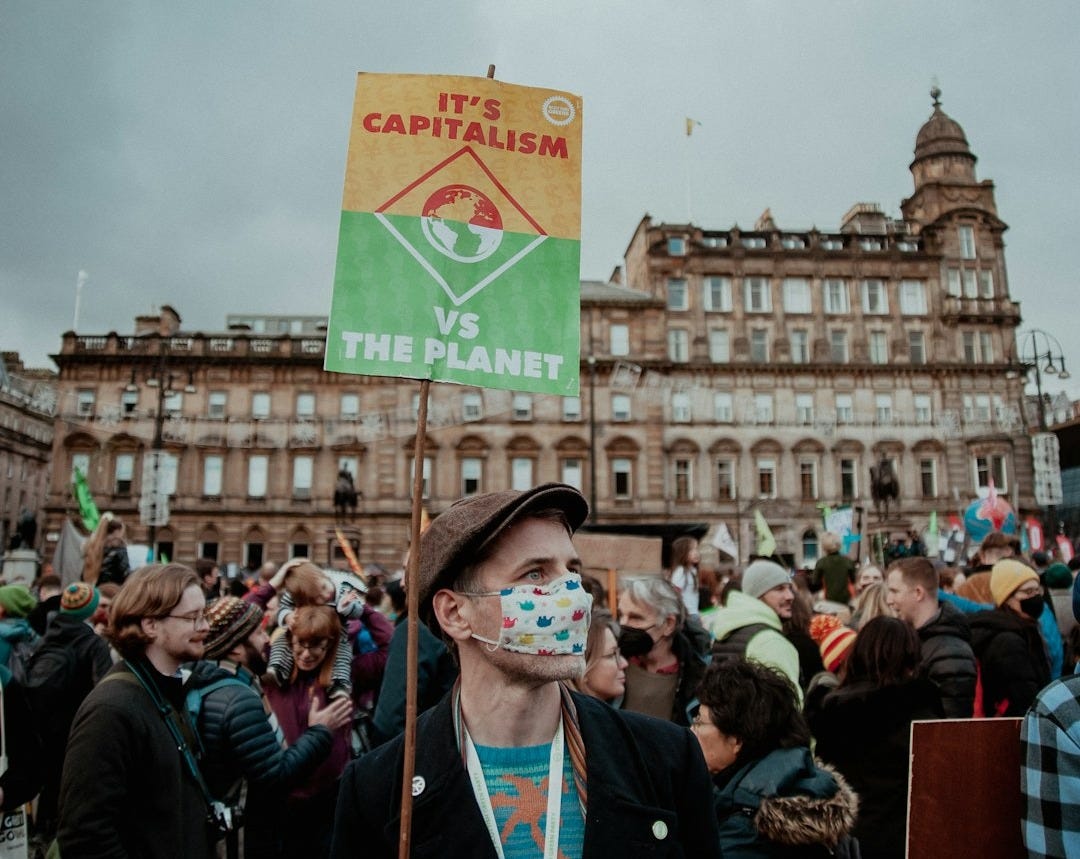
So the trend for the early part of our generation and for the major part of our previous generation has been this thing called capitalism. What is funny about it is that we now feel that we are the most modern humans that have existed on this planet. And without conclusive proof stating otherwise, we seem quite convinced that this is so. But just because we can’t find it, doesn’t mean the evidence doesn’t exist.
Photo by William Gibson on Unsplash
Capitalist Realism
An idea put forth by the philosopher Mark Fisher, it is an insightful take on what happens when society thinks the current alternative is the best there is. While we might touch on financial aspects, this essay is more directed towards the social and individual effects of Capitalism. Fisher described capitalist realism as “the widespread sense that not only is capitalism the only viable political and economic system, but also that it is now impossible even to imagine a coherent alternative to it.”
As Fisher writes in ‘Capitalist Realism’:
This haunting description captures how capitalism survives not through inspiration, but through the exhaustion of alternatives.
This feeling of ‘stuckness’ is something I relate to. Capitalism and its goals set for the individual have always made me feel like a failure. The myth of hard work and pushing oneself to work up the ladder of meritocracy felt off to me. It was indeed in the boomer generation that one could truly work themselves up from nothing to buy a house, to have a decent life and lift themselves out of abject poverty. But now, things are different.
Workers in the UK, for example, are living with their parents while drawing a great salary. They are people in their late-twenties, early thirties. They are saving up to buy a house but the price of houses keeps increasing—and it’s going up faster than their savings. Then we have people of the same age but who have inherited a large amount of money. They’re able to own houses because they already have the capital available. Not only that but they can employ their surplus capital to make more money.
We see this financialization playing out dramatically in the food industry, where massive investment firms now control vast agricultural lands not to grow food, but to speculate on future prices. Farmers who once made decisions based on local needs now plant crops based on global market predictions. Real food—the stuff that keeps us alive and promotes our wellbeing—becomes abstract numbers on a trading screen, while people go hungry in a world of plenty. This disconnect between financial abstractions and physical reality shows how far we’ve strayed from economic common sense.
Fisher criticised how much finance and the financialization of everything has come to dominate our economy. Growing financial instruments, which involve making money from money, are slowly getting much more popular than producing goods or services. We, who are stuck in late-stage capitalism, need to fear if this could someday happen. If, someday, more people were busy with the stock market than growing food. If, someday, we would need to realise we can’t eat money.
His view was that financialization came with the rise of Neoliberalism – an ideology that emphasizes free markets, deregulation and privatization. It was a concerted effort to remove the government influence from the markets. Neoliberalism emerged in the 1970s as an economic philosophy championing individual responsibility, free markets, and minimal government intervention. At its core, it views competition as the defining characteristic of human relations and redefines citizens as consumers whose democratic choices are best exercised by buying and selling.
The belief was that the market is self-regulating and no governing body can match the self-correcting potential of actual free markets, without limits. How wrong was that idea. Fisher’s feeling, and of those around him, was that capitalism was gradually detaching itself from reality and becoming a ‘virtual’ system that operates according to its own logic regardless of the consequences of people and planet.
It is also those at the very top of the capitalist system that have much influence in the direction this takes. I do not think they are malicious but merely self-serving as most humans are. They are also so disconnected from the ground-level reality of things—or find this reality hard to digest—that they do not know the real effects of their decisions. Over time, we can see the rise of economic inequality and sadly, also the slow erosion of social solidarity. Where we once supported each other, now it’s everyone for themselves and we start to mimic the self-serving behaviour of those we secretly idolize. This has naturally led to a disappearance of our sense of collective responsibility—because somehow we believe no one else cares so we don’t have to either.
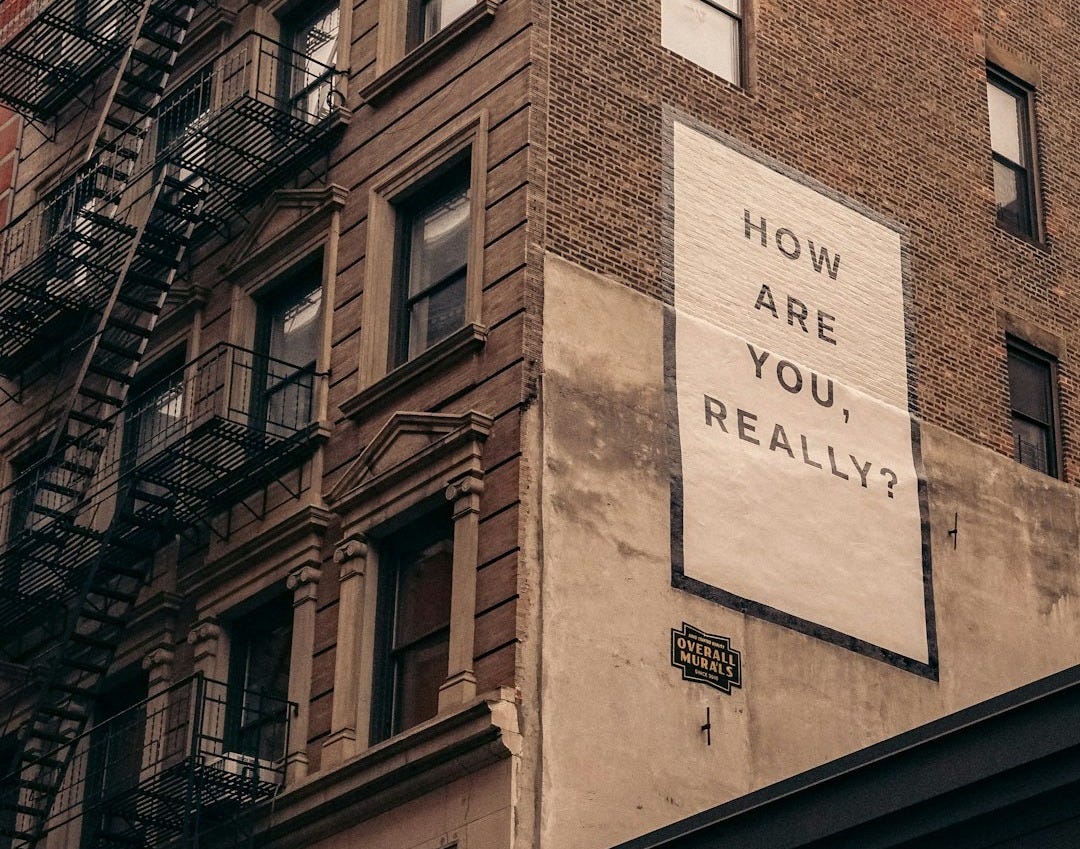 Photo by Mitch on Unsplash
The Mental Health Problem
People do care though, they care more than we can know. But we’re all trapped and need to look out for ourselves. The will to survive is more primal than the instinct to cooperate. And because there is very little to give us meaning today, we default to a kind of narcissism that is very easy to see and everywhere today. We talk about ourselves, we boast our accomplishments, our desires, our plans for the future and our beliefs—but secretly I’m sure we doubt all of these things regularly and heavily.
We can’t change this system alone but we’re too busy building our personal brands or helping someone else build theirs to even think about change. We can’t imagine something different because all of this is just honestly overwhelming. And so, we have the mental health crisis. The feeling of stuckness, along with the imperative to constantly achieve and the pressure to perform is slowly eroding something inside us. Just like capitalism, we’re repeating same old ideas and the ways of doing things that once felt exciting, but they’re not making us happy anymore. So, we give up but we keep going.
Fisher suggested that mental health problems should be seen as political issues and not just personal ones. He argued that the focus on individual achievement and competition is making people feel isolated and inadequate, leading to depression and anxiety. The approach of modern clinical therapy to link these problems to either one’s biology or brain chemistry or childhood trauma is making all this just about the individual and not about society. Fisher also wrote, “If it is true that mental illness is increasing, it is because of the kind of society we live in, not because of some biological or genetic predisposition.”
He pointed out that capitalism often makes us feel like we’re failing even when we’re not. It sets up unrealistic expectations and then blames us when we can’t meet them. This can lead to feelings of inadequacy, anxiety, and depression. He saw this as a form of “reflexive impotence,” where our belief that we’re powerless actually makes us less likely to act and change things.
This reflexive impotence becomes a self-fulfilling prophecy – we feel powerless because we can’t imagine change, and we can’t imagine change because we feel powerless. It’s a psychological trap that serves capitalism perfectly: the more defeated we feel, the less likely we are to challenge the system. Breaking this cycle requires recognizing that our sense of powerlessness isn’t natural or inevitable. Not at all! Rather, it’s a learned response to a system that benefits from our resignation.
One of the main points of my book was to illustrate how we’re connected to everything and that we’re not isolated individuals on this planet just put here to do work and make money. While these things are important, there is a larger perspective we’re often missing. Like the fungus we see in a forest is connected beneath the ground in a large mycelium network, we’re also connected to each other by some kind of human Wi-Fi! Although our connections are not physically visible that doesn’t mean they don’t exist. I can’t see air but I never claim it doesn’t exist.
Studies on depression have proven that if a patient is moved from their original environment to one that is calmer, less stressful and offers more support, they improve. The depression goes away because our environment affects us deeply, but like a fish in water we’re oblivious to it. Of course biology plays a role but we can’t just ignore the impact of socio-economic factors.
Fisher wanted us to understand that our mental well-being is connected to the wider world and that changing society can be a way to improve our mental health. In his own words: “It is necessary to reframe the growing problem of stress (and distress) in capitalist societies. Instead of treating it as incumbent on individuals to resolve their own psychological distress, instead, that is, of accepting the vast privatization of stress that has taken place over the last thirty years, we need to ask: how has it become acceptable that so many people, and especially so many young people, are ill?”
The Importance of Imagination
This collective illness points to something deeper than individual suffering—it reveals the limits of our imagination under capitalism. When we can’t envision alternatives to our current reality, our minds become trapped in cycles of hopelessness. The very system that breeds our anxiety also constrains our ability to imagine solutions. Breaking free from this mental prison requires us to first acknowledge that our psychological struggles aren’t just personal failures, but symptoms of a larger systemic crisis. Only then can we begin to imagine new possibilities.
To change something in society we have to take action but before we do that, we have to pause! Pause and cultivate the ability to imagine a different future. We have to be able to doubt the narratives we’re getting and start questioning even our assumptions. Because where do they come from? They come from our environment, from society and the natural way we take cues from our surroundings while growing up. But if those cues are now causing sickness, we should be ready to even discard our deepest held beliefs.
Fisher wrote: “It’s easier to imagine the end of the world than the end of capitalism.” And that’s why it is a powerful idea that has grasped us so tightly.

I would like to quote a paragraph verbatim from this article from Jacobin magazine :
Yet all around us we see that capitalism engenders misery. In one corner of the world, white-collar workers languish in grim cubicles, alienated from their labour, compiling spreadsheets for a multinational electronics corporation. In another, slum-dwellers melt the discarded electronics to extract their metal, which they sell for money to eat. The seas rise and the hills catch on fire, the body breaks and there is no money for a doctor, and every few years the markets fail, cancelling the future that a lucky handful of working people have been able to secure (or so they believed).
The question, then, is why capitalist realism persists, when conditions under capitalism are so evidently untenable. In “Not Failing Better, But Fighting to Win,” Fisher wrote:
“In my view it is because it was never really necessarily about the idea that capitalism was a particularly good system: it was more about persuading people that it is the only viable system and that the building of an alternative is impossible… that capitalism is almost like a force of nature, which cannot be resisted.”
Why he calls this a ‘realism’ is because it mistakes an ideology for something that is real. It seems real but only because capitalism excludes the facts that lie outside its ideology, either berating them or ignoring them entirely. This ideological blindness operates like a self-fulfilling prophecy—capitalism isn’t just an economic system, but a lens through which we see reality itself. It shapes what we consider possible, practical, or even imaginable. When we treat market logic as natural law rather than human creation, we forget that economics is meant to serve human needs, not the other way around.
So, in order to extract ourselves from the grips of yet another historically inaccurate ideology, as human beings regularly must start looking at the facts. Climate change, mental health and excessive bureaucracy are some of the highlighted weaknesses of the current system. The class inequalities, the unsustainable rising of prices and degradation of culture are some more examples. But I would urge you to find your own because there is no amount of theory that can replace a vivid, relevant and real example.
Fisher stressed the importance of collective action. That we must see ourselves as a globally connected organism, rather than isolated individuals. We cannot face these challenges alone. He also believed in “popular modernism” where normal people like you and me become active participants in shaping our own future rather than just choosing the sad set of options the market offers. We need a kind of solidarity large parts of our society may have forgotten.
He spoke of the “collective capacity to dream” and while we are unable to imagine different futures now, it is imperative that we do. We need to reawaken those impulses. For if we look around at the world we live in, this kind of world was once someone’s dream—and we’re living it! Of course they didn’t dream of the problems and inevitably, any future will have its problems. We need to first dream and then act. We need to experiment with different and novel ways of living and in this way, we will challenge the dominant narratives which are keeping us stuck.
The time we are giving to a future that is making us sick must be reclaimed. We have to resist the pressure to constantly work and consume. This, too, is part of what will bring change. We need policies that prioritize our human well-being and that stops treating us like machines to be fine-tuned or resources to be exploited. We need to do something different otherwise we will continue to get what we have always gotten.
Mark Fisher died tragically by suicide in 2017 after having struggled with mental health for many years. I would like to thank Stephen West for introducing me to his work as his legacy survives and becomes more relevant with each passing year. His life is a testament to the lack of supportive mental health circumstances and the importance of challenging what we deem to be normal and acceptable. Society exists and it must reinvent itself constantly—especially if we’re wreaking havoc on the planet and our souls.
We’re all in this together and in our struggle against capitalist realism, we may remember that hope isn’t just optimism – it’s a form of resistance. Like Bukowski reminds us in this poem, even in our darkest moments, there are always possibilities for change, always chances to reclaim our lives from the machinery of capitalism:
“your life is your life
don’t let it be clubbed into dank submission.
be on the watch.
there are ways out.
there is a light somewhere.
it may not be much light but
it beats the darkness.
be on the watch.
the gods will offer you chances.
know them.
take them.
you can’t beat death but
you can beat death in life, sometimes.
and the more often you learn to do it,
the more light there will be.
your life is your life.
know it while you have it.
you are marvellous
the gods wait to delight
in you.”
― Charles Bukowski, The Laughing Heart